Sovereign Data Foundation for Institutional Intelligence

Turning raw data into an institutional asset. We bridge the gap between static ingestion and the high-concurrency architecture required for real-time intelligence.

Our Core Capabilities

We architect the foundational systems required to transition legacy environments into production-ready ecosystems across cloud, hybrid, and on-premise infrastructure.

Data Platforms​

Architecting the Resilient Systems of Record.

High-Concurrency Infrastructure

We design hardened foundations that serve as the single source of truth for the enterprise. These platforms are architected for sub-second latency and zero-loss ingestion, ensuring data is available for mission-critical intelligence at global scale.

Core Ecosystems

Cloud: Snowflake, Databricks, Synapse, Fabric, ADLS, Redshift, S3, EMR, Glue, BigQuery
On-Prem/Hybrid: Cloudera, Hadoop, Teradata, Oracle, SQL, MongoDB, PostgreSQL.
We also lead data lakehouse architecture and SQL modernization initiatives

Mechanics of Ingestion

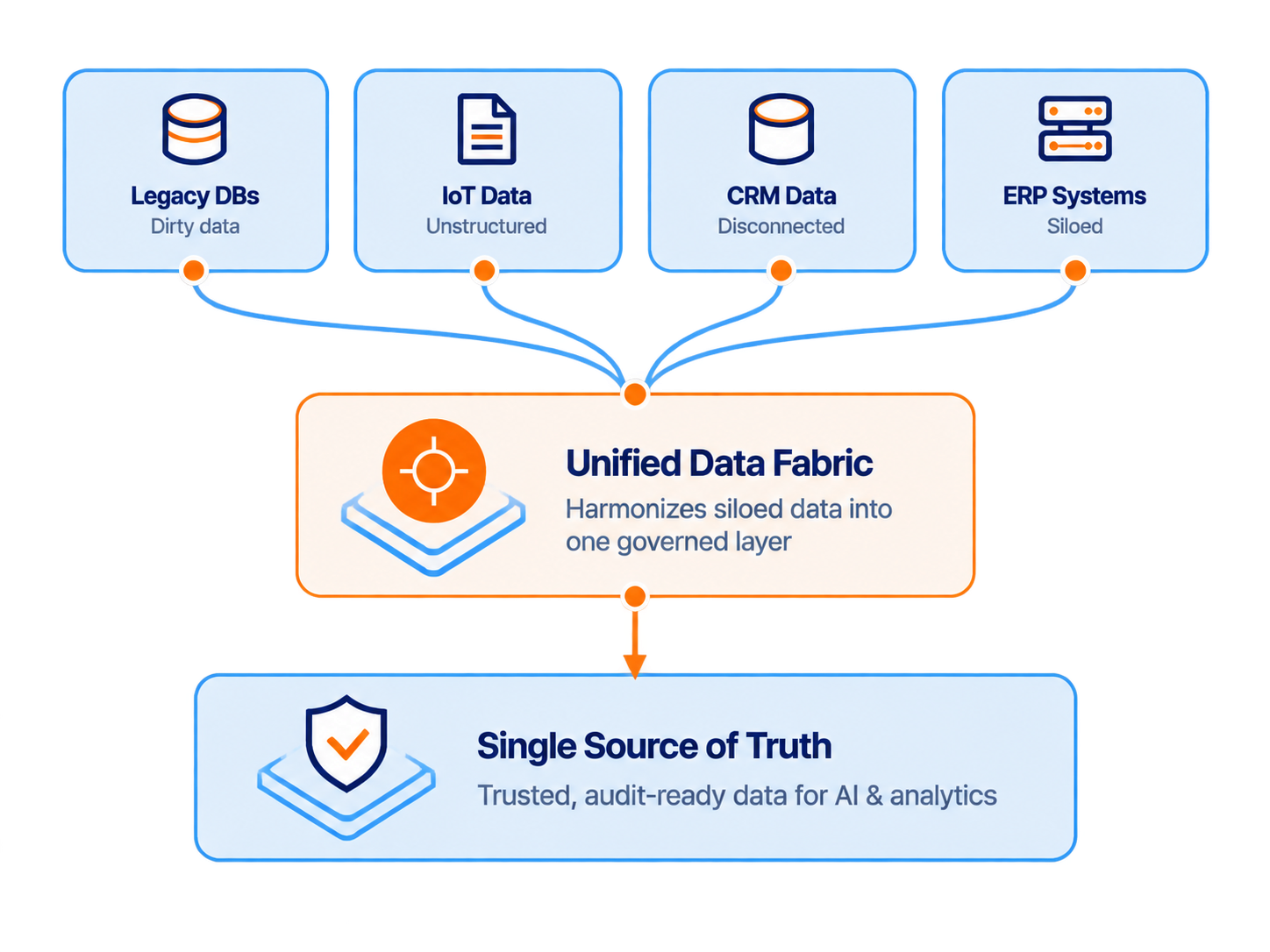
We orchestrate the unified ingestion of structured, semi-structured, and unstructured data across on-premise, cloud, and hybrid environments. We utilize high-throughput ETL/ELT, Data Factory, Change Data Capture (CDC), and API Mesh to move data from legacy complexity to production-ready ecosystems

Institutional Governance

We implement enterprise-grade governance that treats data as a strategic asset. By enforcing rigorous quality standards, automated lineage tracking, and granular access controls, we ensure your organization operates on “Trusted Data” that meets FedRAMP, HIPAA, and 21 CFR Part 11 mandates. By integrating Data Cataloging, Automated Lineage, RBAC, and unified Monitoring/Logging, we ensure the platform is self-auditing and natively compliant.

Data & ML Ops

High-Velocity DataOps

Autonomous Pipeline Orchestration.We implement high-concurrency, event-driven architectures utilizing Airflow, Spark, and Kafka. By engineering “Self-Healing” protocols and automated alerting, we resolve pipeline failures in near real-time. This minimizes “Data Downtime” and ensures strict adherence to Data Freshness SLAs across disparate global systems.

Mission-Critical MLOps

Production-Grade Model Integrity. We operationalize AI through containerized serving and rigorous observability. Our framework tracks data and concept drift with automated retraining triggers to prevent performance degradation. We ensure stability in regulated environments through advanced deployment strategies, including A/B testing, Shadowing, and Canary rollouts.

The Unified Ops Fabric

Rather than treating Data, DevOps, and ML as isolated functions, we architect a unified operational fabric.

DataOps | The Foundation

Automating the data lifecycle from ingestion to “Gold Record” status with continuous freshness and integrity monitoring built into every pipeline

DevOps | The Skeleton

Building Sovereign Infrastructure across Cloud, On-Prem, and Hybrid environments with Zero-Trust security and automated CI/CD pipelines.

MLOps | The Intelligence

Bridging the gap between model development and production. We ensure your AI models are scalable, versioned, and, most importantly, Explainable.
This unified operational loop serves as the foundational infrastructure for Intuceo’s proprietary intelligence assets. Intuceo-Ax™ (Decision Intelligence), Intuceo-Ix™ (Neural Search), and Intuceo-Dx™ (Document & Vision Intelligence) are each designed to sit directly on top of this DataOps and MLOps fabric, activating stored data into explainable, production-ready insights without requiring a full infrastructure overhaul.

Strategic Data Engineering Pillars

End-to-End Data Orchestration

In manufacturing environments, these orchestration capabilities ingest and harmonize high-velocity IoT sensor streams, SCADA telemetry, and MES data into unified production data lakes, providing the real-time foundation for predictive maintenance, yield optimization, and OEE tracking.

Explainable ML Ops (XAI)

In Life Sciences, these explainability frameworks automate the classification of adverse events while generating the evidence-based rationale required for GxP and FDA regulatory submissions. For pharmaceutical R&D and pharmacovigilance teams, this eliminates thousands of hours of manual explanation writing while maintaining 100% regulatory fidelity.

The Intuceo Intervention

Data Swamp Bottleneck
For supply chain and logistics networks, these pipelines orchestrate data from disparate carriers, EDI systems, and ERP platforms (SAP, Oracle, Microsoft Dynamics) into a single operational truth, enabling real-time shipment visibility and financial reconciliation.
In Healthcare, the same Risk Stratification pipelines power Clinical Risk Group (CRG) classification and predictive care management, enabling payers and providers to identify high-utilizer populations and trigger proactive interventions before conditions escalate.

Data Ecosystem

For pharmaceutical organizations, this Compliance-by-Design approach ensures every pipeline satisfies FDA 21 CFR Part 11 and GxP mandates without adding manual overhead to engineering cycles. For federal agencies and defense contractors, our DevOps protocols are natively aligned with FedRAMP, FISMA, and NIST 800-53 standards, supporting Authority to Operate (ATO) certification pathways. Intuceo holds GSA MAS Schedule access (Contract: 47QTCA24D00EH) for streamlined federal procurement.

Case Studies

Resources

Frequently Asked Questions

What is the difference between Intuceo's DataOps approach and a standard ETL pipeline?
A standard ETL pipeline is a linear, often brittle process that moves data from point A to point B without contextual quality controls. Intuceo’s DataOps is a continuous operational loop that integrates automated quality testing, data versioning, full-stack observability, and self-healing protocols. The result is 99.9% data freshness, zero-loss ingestion, and a resilient foundation that is inherently ready for high-precision AI and ML workloads—something a traditional ETL cannot guarantee.
Intuceo implements Sovereign Infrastructure protocols that go well beyond basic encryption. This includes VPC isolation, Customer-Managed Encryption Keys (CMEK), and granular Role-Based Access Control (RBAC) and Attribute-Based Access Control (ABAC). These measures ensure that your organization retains absolute residency and ownership of its intellectual property, regardless of whether workloads reside on Azure, AWS, GCP, or in a hybrid configuration.
The Unified Ops Fabric is Intuceo’s integrated operating model that treats DataOps, DevOps, and MLOps not as isolated functions but as a single, cohesive discipline. DataOps provides the automated, high-integrity data pipeline; DevOps builds the sovereign infrastructure with zero-trust security; and MLOps bridges model development to production with explainability and governance. This unified approach minimizes the silos and hand-off gaps that typically cause 80% of AI models to fail before reaching production.
Intuceo builds Compliance-by-Design into every layer of the architecture for regulated industries. Automated audit log generation, lineage tracking, and security reporting are embedded directly into the data platform, ensuring organizations remain audit-ready without sacrificing development velocity. Intuceo’s governance frameworks are pre-validated for GxP, HIPAA, FedRAMP, and federal audit standards, turning compliance from a bottleneck into a built-in capability.
Intuceo is expertise-driven across the full enterprise data stack. On the cloud side, supported platforms include Snowflake, Databricks, Azure Synapse, Microsoft Fabric, ADLS, Amazon Redshift, S3, EMR, Glue, and Google BigQuery. For on-premise and hybrid environments, Intuceo works with Cloudera, Hadoop, Teradata, and Oracle SQL Server, as well as modern Data Lakehouse and SQL Modernization architectures.
Explainable MLOps means engineering AI pipelines that allow models to rationalize their predictions with human-readable evidence rather than producing opaque binary outputs. For regulated industries in Pharma, Finance, and Federal sectors, auditability is not optional—it is a mandate. Intuceo’s XAI approach integrates an evidence layer into the model lifecycle, enabling interpretability dashboards and automated justification trails that satisfy the transparency requirements of FDA, NIST, and financial regulatory bodies.
Data Downtime—when pipelines fail silently and AI models are fed stale or corrupted data—is addressed through Intuceo’s Self-Healing Infrastructure. This includes automated alerting, auto-healing protocols that resolve pipeline failures in real time, event-driven architectures using Airflow, Spark, and Kafka that trigger downstream AI workloads the moment new telemetry is ingested, and full-stack monitoring of data freshness, volume, and schema drift.
Operational fragility refers to the well-documented phenomenon where AI models that perform well in controlled lab settings fail at enterprise scale due to infrastructure gaps, high concurrency demands, and insufficient deployment governance. Intuceo addresses this with hardened MLOps pipelines that automate model deployment and scaling, provide a production-ready environment capable of handling sub-millisecond latency at scale, and include advanced deployment strategies such as A/B testing, shadow deployment, and canary rollouts.
Intuceo is tool-agnostic but expertise-driven across the institutional stack. For data engineering: Snowflake, Databricks, dbt, Kafka, and Spark. For cloud and DevOps operations: Terraform, Kubernetes, Docker, Jenkins, and GitLab. For AI and ML lifecycle management: MLflow, Kubeflow, Amazon SageMaker, PyTorch, and TensorFlow. This curated, battle-tested stack ensures consistent, scalable, and governable results across diverse enterprise environments.

The Right Ops Partner Doesn't Just Implement-They Stay Accountable.

Intuceo doesn’t hand off at go-live. We build, monitor, and continuously improve your DataOps and DevOps infrastructure alongside your team — because operational excellence isn’t a project, it’s a practice.
Every DataOps and DevOps engagement follows Intuceo’s proprietary iPDLC™ methodology, a disciplined AI development lifecycle that embeds PhD-led quality gates from initial data discovery through production-grade deployment. iPDLC governs the path from raw pipeline requirements to self-healing production infrastructure, ensuring that every deliverable is built for scalability, compliance, and long-term maintainability. Explore the iPDLC™ Framework