






The Pareto Front in multi-objective engineering optimization represents the set of design solutions where no single objective (such as weight, stiffness, cost, or crash performance) can be improved without degrading another. Intuceo’s Intuceo-Ex engine identifies the Pareto Front of design performance across competing engineering objectives, giving teams a rigorous, mathematically defensible basis for design decisions rather than relying on intuition or single-variable trade studies.
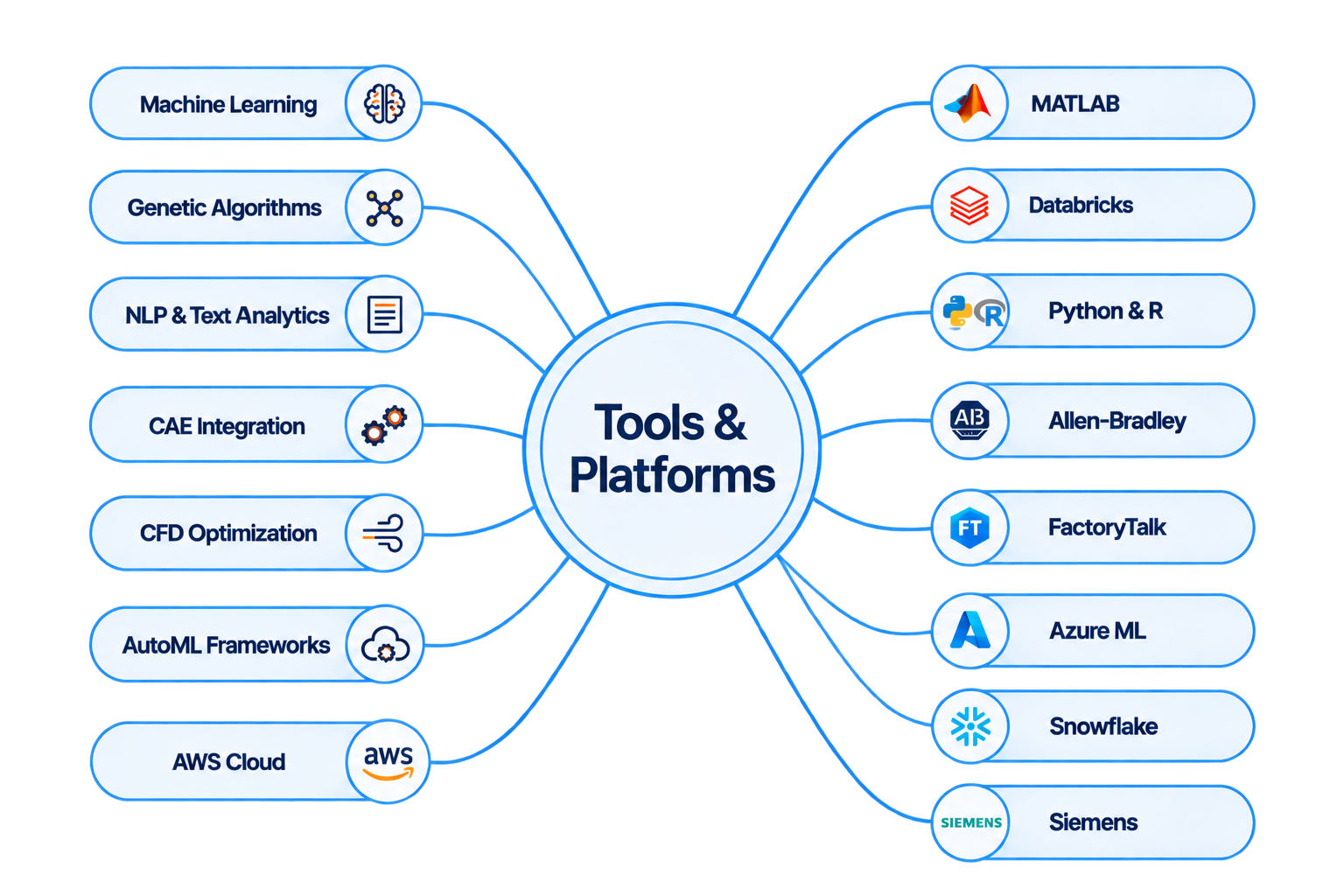
Intuceo’s NLP-Driven Quality Analytics applies Natural Language Processing to mine customer warranty claims, dealership feedback, and field reports for patterns related to BSR (Buzz, Squeak and Rattle) issues, early failure modes, and recurring quality complaints. By closing the feedback loop between post-market consumer data and front-end engineering design decisions, Intuceo helps OEMs proactively address quality issues in future model year vehicles directly improving JD Power Initial Quality Study and Vehicle Dependability Study scores.
Intuceo has delivered documented cost savings through ML-driven spot weld optimization that uses finite element analysis data and machine learning to identify redundant welds that can be eliminated without compromising structural integrity or safety standards. This approach has achieved significant reductions in the total number of spot welds required for body-in-white assemblies, directly reducing cycle time, energy consumption, electrode wear, and material costs across high-volume automotive production programs.
The Digital Thread is the continuous, traceable flow of data from R&D simulation through manufacturing execution to field performance and warranty feedback. Intuceo engineers this thread by integrating CAE outputs, MES production data, sensor telemetry, and post-market analytics into a unified data platform. This enables engineers to see in near-real-time how design decisions are translating into production quality and field reliability, closing the loop between virtual design and physical reality.
Intuceo utilizes MES and sensor data to apply machine learning models that identify manufacturing variances and process signatures correlated with downstream defects—before those defects are produced. By monitoring process parameters such as welding current, pressure, temperature, and cycle time in real time, the system can trigger alerts or automatic process corrections when anomalous conditions are detected, enabling defect prevention rather than defect detection.
Intuceo achieves 4X accelerated implementation using its AutoML tools and iPDLC frameworks compared to traditional engineering consultancy approaches. This has enabled Intuceo to move engineering AI roadmaps from concept to production in weeks rather than quarters. Across more than 250 successful AI and ML implementations for Fortune 1000 automotive and engineering leaders, Intuceo has proven the consistency of this delivery velocity at enterprise scale.
Intuceo has delivered AI and analytics solutions for industry leaders including Bosch, ASM, Mahindra, Nissan, Chrysler (Stellantis), and Cyient. With over 20 years of industrial engineering domain expertise combined with PhD-level data science, Intuceo brings a depth of sector-specific understanding that spans vehicle dynamics, body engineering, powertrain performance, manufacturing quality, and supply chain resilience across the global automotive value chain.